Few destinations offer as many challenges, or as many thrills, as Tsimane, in the high forests of southwest Bolivia. Tsimane is a magical place; its various lodges and camps offer access to stunningly beautiful waters in an impossibly far-flung corner of the Amazon basin. The Secure River is a wild place, full of big, hard-fighting fish, but a handful of tiny tributaries are utterly enchanted: a clutch of crystal-clear
freestone streams that come tumbling out of the Andean foothills on their relentless rush towards the Secure and eventually the mighty Amazon and the Atlantic Ocean itself. The Pluma, the Itirisama and my favourite, the tiny Agua Negra, are as bewitching and as remote and untouched as you could ever hope to find. Each of these exquisite little gems offers some of the most fabulous fly-fishing on earth.

This is no novelty fishery. A trip to Tsimane is, for sure, a unique hard-core adventure deep in the heart of the immaculate rainforest, but over and above the remarkable experience of being in one of the most isolated and pristine environments on earth, Tsimane’s fishery will test the versatility of your technique and ability to the maximum, and its fish will thrill you like few others. Pack every trick and technique you’ve ever picked up on your travels to this wild wonderland, and you can almost depend on it having a part to play. Tsimane has elements of almost every other great fly-fishing experience out there wrapped up in a thrill-a-minute rollercoaster ride, and it is a true test of any fly-fisher’s mettle.

Your central target is Salminus Brasiliensis – the freshwater Dorado: these astonishing, razor-jawed golden creatures are impossibly magnificent to look upon, but first you have to catch one: be warned, they can be as diffident as the big, spooky trout of a New Zealand stream, or as dementedly aggressive as the giant trevally of an Indian Ocean flat. Within an hour, you can find yourself “trout-hunting”, crawling around boulders on all fours and holding your
breath as you stealthily cast to the big singleton holding right there in a gin-clear pocket the size of a dining table, or running towards a blood-curdling, fish-busting conflagration as a horde of these golden killers attack the sabalo baitfish shoals in a wild and merciless blitz. Knowing how to throw big, bulky flies quickly and accurately is absolutely key in nailing one of these crazed assassins before they can grab a big appetite-suppressing meal, and in this scenario, talented saltwater anglers will thrive.

After a storm has lit up the emerald forests with a thousand thunderbolts and a million big, fat drops of rain, the rivers will color up fast, and you’ll need to rely on yet another set of skills. The fish may go off the feed for a day, but as the river slowly drops and starts to clear, they will be hungry, and you may experience the wildest and most prolific day of your trip. While sight-fishing is no longer possible in the still-turbid water, your steelhead or salmon-fishing experience will tell you exactly where those fish will be holding, and how fast and deep to swing your fly. Put in a big, aerial mend, and ease the big Andino Deceiver into that soft slot of pocket-water behind the boulder: jig the rod-tip to bring your fly alive and you may just find yourself slugging it out with a thirty-pound trophy that puts all but the feistiest Alta salmon or Dean River steelhead to shame.


Go ahead and fill your boots: if you’re anything like me, you’ll get a big dose of gold fever, and never tire of catching these absurdly strong, acrobatic and exquisitely beautiful fish, but if you really want another challenge, have a shot at the wily Pacu. Pacu are the perfect antidote to all that Dorado mayhem – big, slab-sided herbivores that mainly feed on the nuts, berries and flowers that fall into the quiet backwaters off of the main current. Getting close to these neurotic fish can be almost impossible, but treat them like the permit of the jungle, and if you can manage to put your imitation right on their nose without sending them scuttling for cover, you might just induce a take. Hang on tight – these things can pull like a train!

If you’ve fished for snook or sabalito tarpon in amongst the mangroves, you’ll be even better equipped: you’ll know how a surface-popper or crease fly can allow you to fish right into structure, and you’ll be able to skim your fly in amongst that birds-cage of fallen branches, where your prize will almost certainly be lurking. Once you see that unforgettable flashing demolition of a take, your times spent wrestling with giant trevally will stand you in good stead as you set hard and bully that big golden brute out into the open.
For the time being, we have any number of beautiful playgrounds in which to enjoy our sport and panoply of fabulous fish to target. Many stick with one species – the boneheads, the permit freaks and the steelhead nuts all preach their own singular religion to anyone who will listen – but to me, the wide variety of species available, with all the myriad environments and challenges they present, is one to be embraced and celebrated.
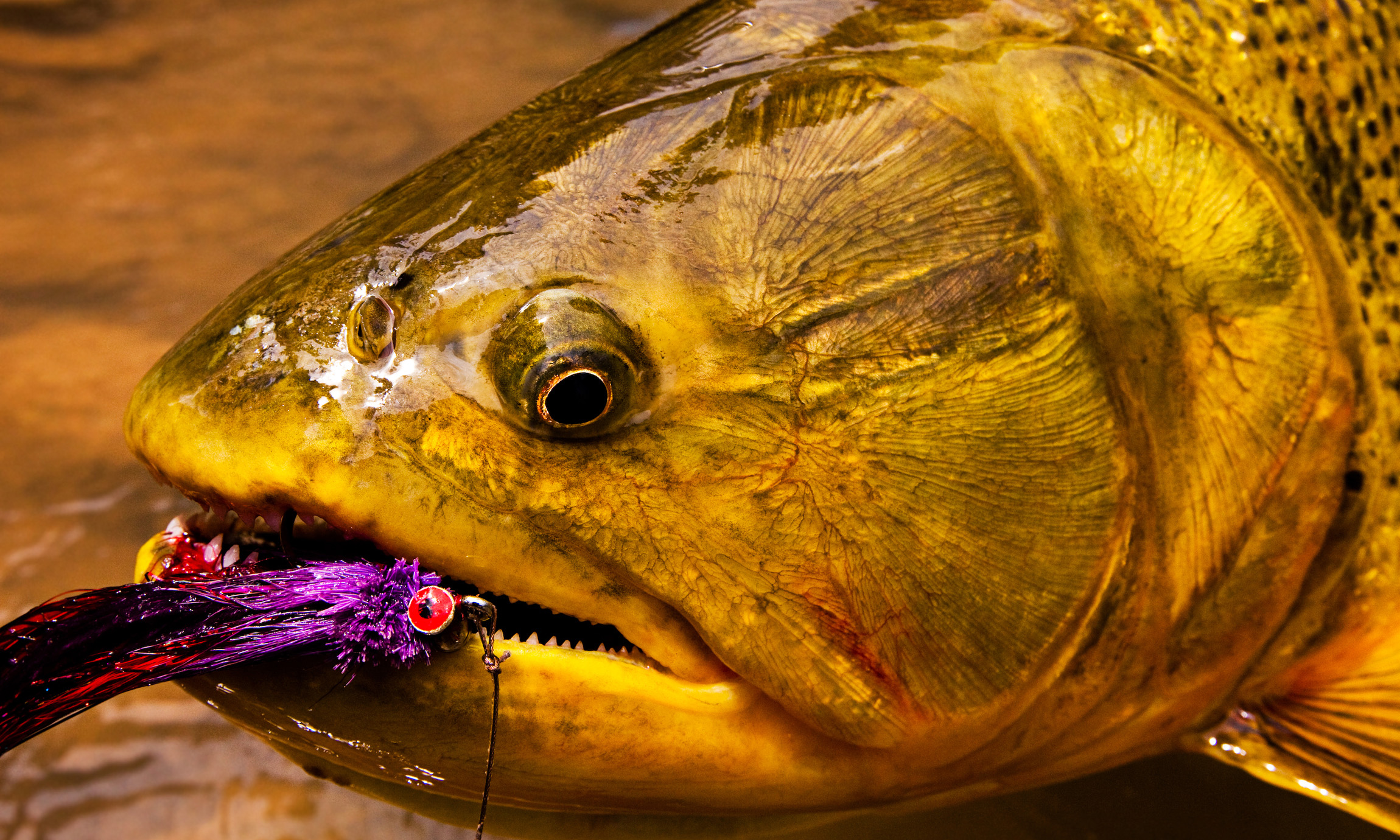
He’ll doubtless go flying up into the crackling heat of the jungle, but if you’ve beaten up plenty of big tarpon on the Florida flats, you’ll instinctively drop the rod tip and bow to the high-flying fish, protecting your tippet and the hook-hold. The moment the fish crashes back into the water, knock the great golden brute off balance with that down-and-dirty move your guide taught you down at Sugarloaf Key.
Slowly, the acrobatics subside, and finally you’re looking at your prize. You may have played all the games that fly-fishing can offer, and you may have seen a billion stunning silver fish from Norway to Cuba to Argentina, but there is only one fish in fly-fishing’s vast pantheon that looks and feels like solid gold. Dorado are one of nature’s true masterpieces and each and every one will all but take your breath away.


There’s plenty more to go at – the hellishly strong Surubi catfish that prowl the bays and frogwater can and will take a fly, and the tricky Yatorana that love to slurp ant imitations off of the surface. Both are absolutely thrilling adversaries, but for me at least, the Dorado is such an addictive drug that I can seldom be dragged away to consider anything else. The action at Tsimane can be relentless, but if you can bear to stop for a moment, take time out to sit in the late afternoon shade and take it all in: fish an icy Paceña beer from the cooler and watch your indigenous Chimane boatmen nonchalantly shoot their sabalo fish supper with bow and arrow, just as they did five thousand years before Cortez and Pizarro. Listen to the magical music of the jungle and try to take in the blizzard of scarlet macaws, chattering monkeys and a million colour-spangled flowers that compete for your attention.


Tsimane is one of the most unique and astonishing fly-fishing environments left on our small, relentlessly over-exploited planet, and each privileged moment in such an intoxicating wilderness should be cherished. For the lucky few that get to experience its bewildering kaleidoscope of sensations, it will leave indelible memories, and for the truly adventurous fly-fisher, there are few, if any locations, to touch it.


Contributed By
Matt Harris
Tsimane is one of the most remarkable fly-fishing operations on earth. Despite its impossibly remote location, the lodges and camps offer five-star accommodation, excellent food and a warm and informal ambience that could not be bettered. Every minute in this very special place is a rare and precious privilege.
Contact: Rodrigo Salles
My trip to Tsimane was organized seamlessly by Tarquin Millington Drake at Frontiers.